



In nuce: The Blender Foundation releases version 3.2 of its open-source 3D tool Blender. Users should be aware of this: Nodes created with Blender 2.93 or an earlier version are no longer compatible with the Geometry Node System. You can find the Blenderian (with the five-minute promise) in the video below.
Feature delights: Below are some of the most relevant features that have been added with Blender 3.2.
- Curve Pen Tool: Bézier curves are created and further edited with it. The built-in control should enable efficient working: Depending on whether you press single, double or hold the control button – or optionally with a custom button – you can switch between different actions. The Curve Pen Tool also allows you to quickly add, delete or adjust control points.

- Grease Pencil Tool: A new envelope modifier has been added. This connects all points that are N points apart – and also draws lines between the points. This creates an effect that looks like a hand-drawn pencil sketch.
- 3D Painting Toolset: According to developer:inside, it is possible to draw on millions of polygons with the Paint in Sculpt Mode – thanks to performance improvements. In addition, the new Paint Brush has been enriched with several settings – including Tip Shape, Wet Mixing, Flow, Density, Brightness, Contrast or RGB values. Did you know? It is now also possible to switch from Paint Brush to Blur Mode. What’s more, you can use the separately selectable Smear Brush to smudge strokes that have already been drawn.

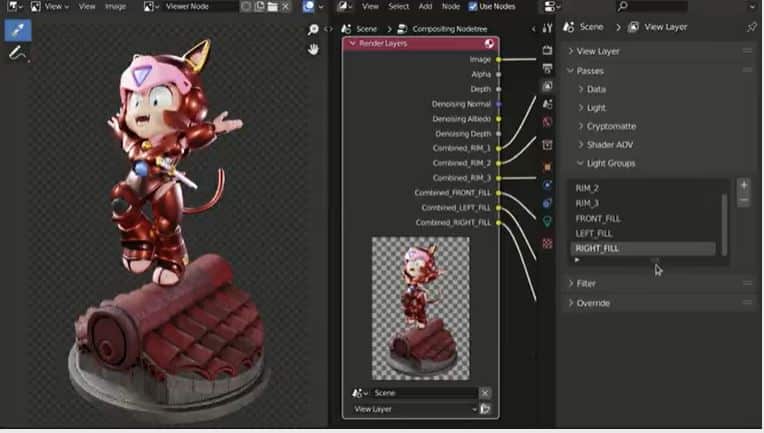
- Light Groups: You can adjust the colours and intensity of light sources with these in the Compositor – without having to render them again. This should work in a similar way to the light mix system in Corona or V-Ray. You can also create render passes that only contain lighting information from a user-defined (sub)group of light sources – for example: only direct lights, ambient lights or emitting materials. Other new features include shadow caustics and volume motion blur.

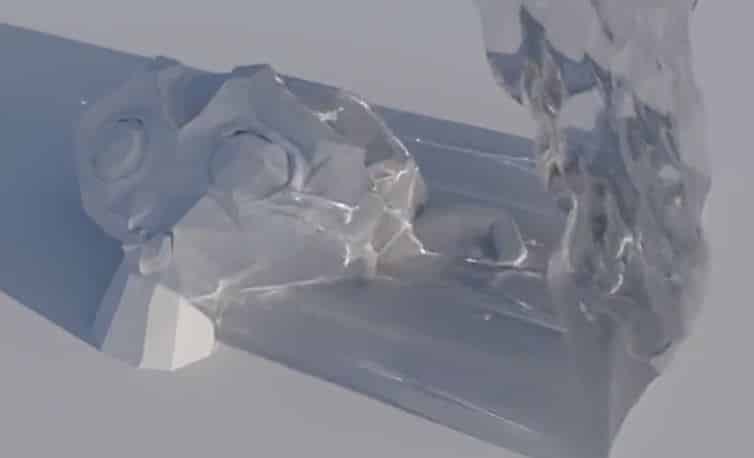
- Shadow Caustics: The caustics system in Cycles has been completely overhauled. For example, Blender 3.2 supports the selective rendering of caustics – more precisely: caustics that are located in the shadow of refractive surfaces. This selective rendering is based on the so-called Manifold Next Event Estimation. Manifold Next Event Estimation is an internal development by Weta Digital, which is intended to reduce higher rendering times caused by caustics. However, there is one limitation: Blender 3.2 currently only supports up to four caustic light reflections at the same time, ignores bump maps and normal maps – and is limited to refractive caustics.

Click further: Click through the corresponding release note and press release to read about all the big and small features of Blender 3.2. You can also put the video below under your retinas to carve all the new Blender features into your cerebral cortex.
Blender 3.2 New Features in LESS than Five Minutes
